Hermes Forward Deployed Engineers
What Hermes Forward Deployed Engineers do, how they use the Hermes Agent framework, and when a business should bring one in.
Most companies do not need another AI demo.
They need a stubborn workflow fixed.
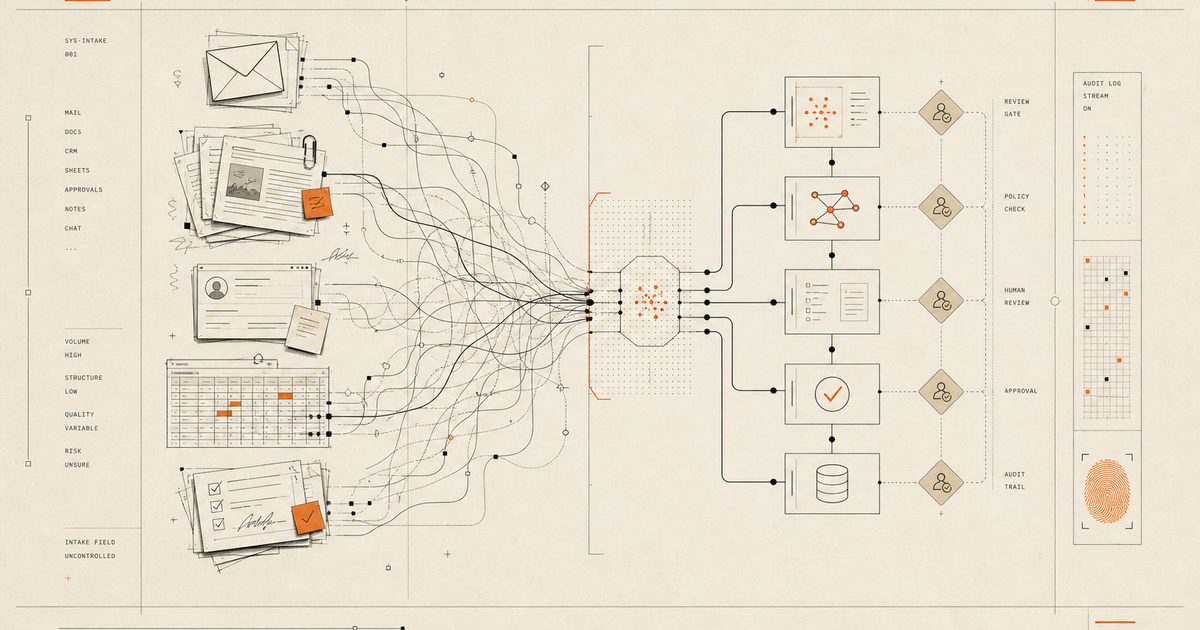
The invoices arrive in one inbox. Approvals happen in Slack or Teams. The CRM is half updated. Reports live in spreadsheets. Someone knows the real process, but mostly because they have been doing it for years and can spot the weird cases by instinct.
Then someone says, "We should automate this with AI."
That is where the gap appears. A model can summarise, classify, extract, draft, and reason. That does not make it a working business system. The hard part is the surrounding machinery: files, permissions, source systems, retries, human approval, audit logs, edge cases, and the boring handoffs that keep the company moving.
A Hermes Forward Deployed Engineer works in that gap.
They use Hermes Agent, the open-source agent framework from Nous Research, to turn messy operational work into agent workflows that run where the team already works: CLI, server, Discord, Slack, Telegram, email, webhooks, cron jobs, and connected business tools.
What is a Hermes Forward Deployed Engineer?
A Hermes Forward Deployed Engineer is an implementation engineer who works close to a business team and builds agent workflows with them, not for them from a distance.
The role sits between engineering, operations, and the people doing the work every day. A Hermes FDE needs to understand the current process, decide where an agent should help, build the integrations, put review controls around the risky steps, and keep improving the workflow after it meets real data.
That usually means:
- mapping how the work actually moves today;
- finding repeated manual work and fragile handoffs;
- connecting inboxes, documents, CRMs, spreadsheets, finance systems, internal tools, and chat;
- giving agents narrow jobs with clear inputs and outputs;
- adding human review where mistakes would be expensive;
- testing on real examples, including the messy ones;
- monitoring failures and tightening the workflow after launch.
The "forward deployed" part matters. The engineer is close enough to notice the approval rule that only applies to one customer type, the spreadsheet everyone calls temporary, and the Friday afternoon handoff that always breaks.
Those details decide whether an AI workflow becomes useful or quietly turns into another abandoned pilot.
What Hermes Agent brings to the work
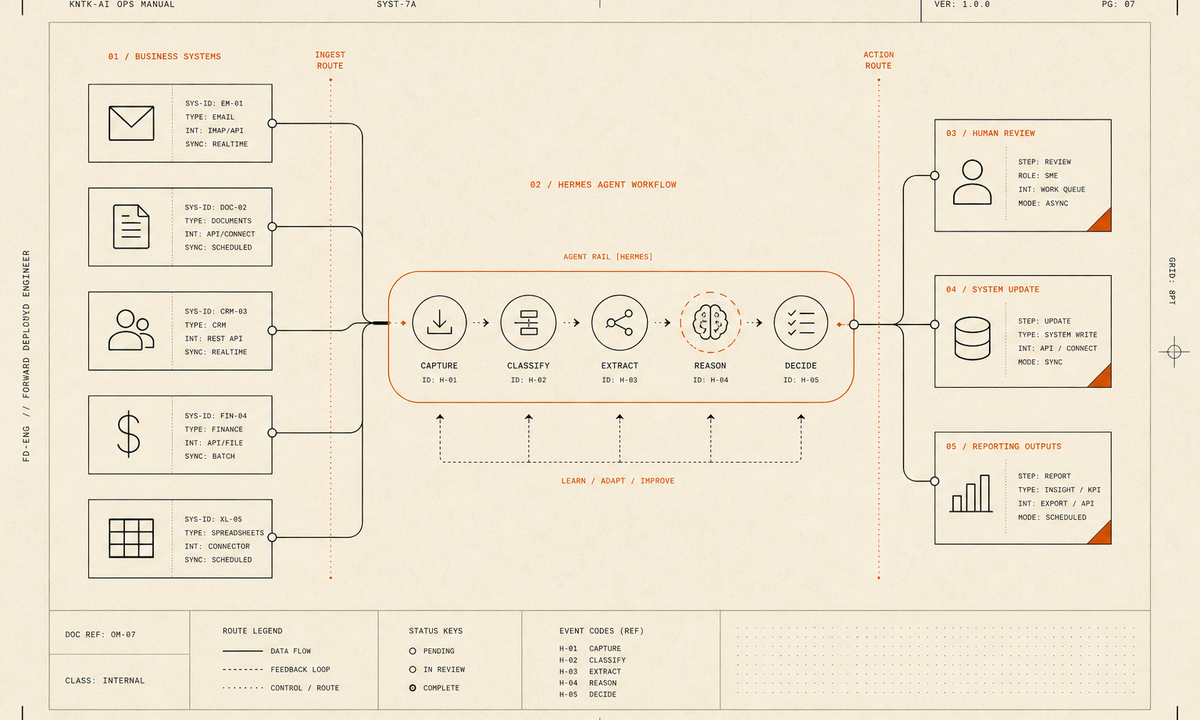
Hermes Agent is not a chatbot wrapper. It is an autonomous agent framework built to run with tools, memory, skills, scheduled jobs, messaging gateways, browser control, terminal access, and subagents.
For forward deployed work, those pieces matter because business workflows rarely live in one clean app.
A Hermes implementation can:
- run from a server instead of someone's laptop;
- talk to users through Discord, Slack, Telegram, email, CLI, or other gateways;
- call tools for files, web, browser automation, terminal commands, APIs, images, voice, and custom integrations;
- remember durable preferences, project facts, and environment details across sessions;
- load reusable skills for known procedures;
- create scheduled automations for reporting, monitoring, follow-up, and recurring checks;
- delegate work to isolated subagents when a job needs parallel research, coding, or analysis;
- use different model providers without rebuilding the workflow around one vendor.
That makes Hermes useful for operational automation. The agent is not trapped in a chat window. It can sit beside the business systems, use the tools it has been given, and report back through the channels the team already watches.
The framework does not remove the need for implementation judgement. It gives the engineer the working layer: tool access, memory, skills, scheduling, messaging, and execution. The FDE still has to design the workflow properly.
Why forward deployed engineering matters for AI
Traditional software projects often start with a spec. Someone writes down what the system should do, engineers build it, users test it, and then everyone discovers the spec missed half the reality.
AI workflows are even more sensitive to this.
Agents read messy inputs, make judgement calls, summarise information, classify requests, extract fields, and recommend actions. That means the implementation depends on context. A small business rule can change the right answer. A missing field can change the route. A client tier can change who needs to approve the output.
A working AI workflow needs answers to practical questions:
- What does a good output look like?
- When is confidence too low?
- Who reviews risky cases?
- Which system is the source of truth?
- What should be automated, and what should stay manual?
- Where should evidence be logged?
- How will users correct the agent when it gets something wrong?
You do not get those answers from a generic AI tool. You get them by working inside the workflow.
What Hermes Forward Deployed Engineers actually do
They map the real workflow
The first job is understanding the current process.
Not the neat version in the process document. The real one.
A Hermes engineer looks at where work starts, where it gets stuck, who touches it, what systems are involved, and what decisions need to happen along the way.
A reporting workflow might include source data from several platforms, manual checks in spreadsheets, commentary from account managers, finance review, deck formatting, and approval before anything goes to the client.
A shallow automation generates a draft report. A useful Hermes workflow handles the chain around it: collection, validation, commentary, review, delivery, and follow-up.
They decide where agents belong
Not every step needs a model.
Some work should be deterministic. Some should be handled with rules. Some should stay with humans. The best systems use agents where they help and avoid them where they add risk.
A Hermes FDE separates the workflow into parts:
- deterministic steps, such as fetching a file or updating a record;
- agent-assisted steps, such as summarising a meeting or extracting fields from a document;
- human decision points, such as approving a recommendation or handling an exception;
- audit steps, such as logging the source, confidence, reviewer, and final outcome.
Bad AI automation tries to make the model responsible for everything. Good AI automation gives the model a narrow job, surrounds it with controls, and keeps people involved where judgement matters.
They connect the systems
Most business workflows are spread across tools: email, Slack, Teams, Google Drive, SharePoint, HubSpot, Salesforce, Notion, Airtable, Xero, Power BI, internal databases, CSV exports, and old spreadsheets that refuse to die.
A Hermes engineer builds the integrations that let agents work inside that environment.
That can mean reading from inboxes, extracting content from PDFs, syncing records into a CRM, creating review tasks, updating spreadsheets, sending summaries into chat, generating client-ready drafts, or triggering follow-up workflows.
This is often the difference between a demo and a system people use. If the output lives in a separate sandbox, adoption is harder. If it appears where the team already works, it becomes part of the operating rhythm.
They build workflows, not prompts
A prompt is not a workflow.
A prompt might summarise a document. A workflow receives the document, checks what type it is, extracts the right fields, validates them, routes low-confidence cases to a person, logs the result, updates the system of record, and notifies the right owner.
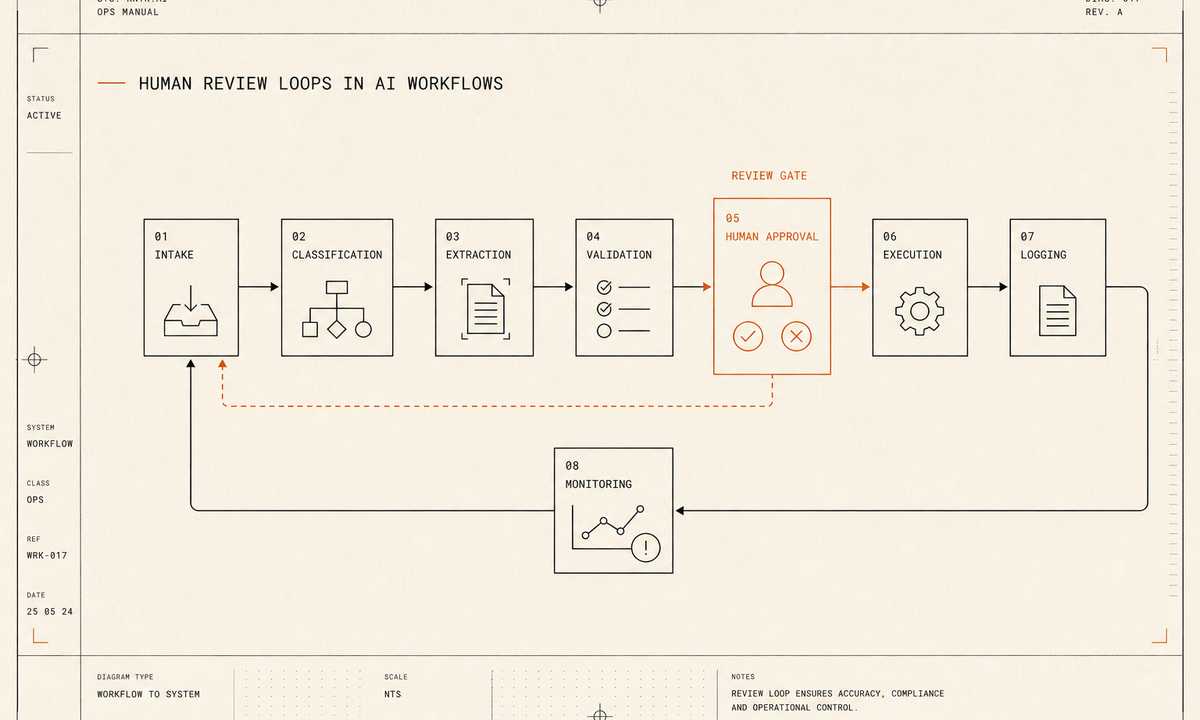
A typical Hermes workflow can include:
- intake from email, upload, webhook, chat, or an internal tool;
- classification of the request or document;
- extraction of structured information;
- validation against business rules;
- a recommended action or draft output;
- human approval for risky or high-value cases;
- execution across connected systems;
- logging, monitoring, and reporting.
The model is one part of the system. The workflow is the product.
They create human review loops
The goal is not to remove people from every process. It is to remove low-value manual work while keeping human judgement where it matters.
Hermes workflows usually include review loops:
- Low-risk tasks can run automatically.
- Medium-risk tasks can be queued for quick approval.
- High-risk decisions can be routed to a named owner.
- Failed or uncertain cases can create follow-up tasks with context attached.
This makes the system easier to trust. People can see what the agent did, why it made a recommendation, and where their input is needed.
Without this, AI systems tend to fail in one of two ways: they automate too much and create risk, or they automate too little and save no time.
They test against real cases
AI workflows need real examples.
A Hermes engineer tests against the business's actual inputs: edge cases, bad files, missing fields, strange document formats, unclear requests, and the examples that never appear in vendor demos.
The question is not whether the model can do the task once. The question is whether the workflow holds up across the range of inputs the team actually sees, and whether it fails in a way people can catch and correct.
Testing also exposes process problems. Sometimes the issue is not the model. It is that the business rule is unclear, the source data is unreliable, or two teams disagree about what should happen next.
They help the team adopt the system
A working AI system still needs adoption.
If people do not trust it, understand it, or know when to use it, they will route around it. The forward deployed role includes enablement because the workflow has to fit the team that will live with it.
The team needs to know what the agent can do, what it cannot do, when to review outputs, how to correct mistakes, and where to find the evidence behind an action.
That is not just training. It is part of implementation.
They keep improving the workflow
AI implementation does not end at launch.
Documents change. Business rules change. People find new edge cases. Integrations break. A good workflow needs a feedback loop.
Hermes Forward Deployed Engineers monitor how the system performs and improve it over time. They look for repeated failures, slow approval points, low-confidence outputs, unclear handoffs, and steps that still require too much manual work.
Sometimes the fix is a prompt change. Sometimes it is a new rule, a better review screen, a tighter integration, or a different process design.
Examples of Hermes Forward Deployed Engineering work
Automated reporting workflows
Many teams spend days collecting data, formatting reports, writing commentary, and chasing approvals.
A Hermes workflow can pull data from source systems, check for missing values, draft commentary, create a review task, and prepare the final output for delivery.
This is useful for finance teams, agencies, operations teams, customer success teams, and any business that regularly produces client or management reporting.
Document intake and processing
Businesses receive documents that need to be read, classified, checked, and entered into another system.
Examples include invoices, contracts, onboarding forms, loan documents, compliance files, statements of work, and support requests.
A Hermes workflow can extract the required information, validate it, flag missing fields, and route exceptions to a human reviewer.
Meeting follow-up and task creation
Meetings create work, but the work often gets lost.
A Hermes workflow can turn meeting notes or transcripts into decisions, risks, tasks, owners, deadlines, and client updates. Instead of relying on someone to rewrite notes after every call, the system creates a draft operating record the team can approve and act on.
CRM and pipeline operations
Sales and delivery teams often have CRM data that is incomplete or stale.
A Hermes workflow can summarise client interactions, update opportunity records, create next actions, and route risks to the right person. The useful part is not "AI updates the CRM". It is that the workflow reflects how the business actually manages relationships, handoffs, and follow-up.
Internal knowledge and research systems
Companies collect useful information in documents, calls, chat threads, and project history. The problem is retrieval.
A Hermes engineer can build workflows that capture knowledge as it appears, structure it, and make it reusable for proposals, briefs, onboarding, delivery, and client work.
When should a company use a Hermes Forward Deployed Engineer?
Bring in a Hermes Forward Deployed Engineer when a workflow is valuable, repetitive, manual, and spread across multiple tools.
Good signs include:
- the team repeats the same manual process every week;
- important work depends on one person's memory;
- data is copied between systems by hand;
- documents need to be read, classified, or checked;
- reporting takes too long;
- meeting follow-up is inconsistent;
- previous AI experiments did not stick;
- the workflow needs human approval and auditability;
- the process touches multiple tools or teams.
A Hermes engineer is most useful when the problem is important enough to justify a custom workflow, but not so cleanly defined that a normal SaaS tool already solves it.
How Hermes FDEs differ from consultants and software engineers
A consultant might analyse the process and recommend a solution. A Hermes Forward Deployed Engineer builds the solution.
There is overlap in discovery and process design, but the output is different. The engineer is responsible for turning the idea into something that works inside the business. That means writing integration code, configuring agents, testing outputs, fixing brittle steps, and changing the workflow when users find problems.
They also work differently from a traditional software engineer. A normal engineer often builds from defined requirements. A forward deployed engineer starts while the requirements are still forming, because part of the job is discovering the real requirements by working with the team.
A strong Hermes engineer can speak with an operations lead in the morning, inspect an API in the afternoon, build a first workflow, and come back with better questions once it hits real data.
That loop is the job.
What makes a good Hermes Forward Deployed Engineer?
A good Hermes engineer has technical skill and operational taste.
They need to understand business processes quickly, ask precise questions, know when AI is the wrong tool, design safe review points, integrate messy systems, test with real examples, communicate tradeoffs clearly, and keep improving the system after launch.
The best ones are not obsessed with impressive demos. They care whether the work got done correctly, faster, and with less friction.
The outcome: agents that become part of operations
The useful version of AI in business is not every employee getting another chatbot.
The useful version is repetitive, information-heavy work moving through the company with less drag.
Documents get processed faster. Reports are drafted sooner. Follow-up stops falling through the cracks. Teams spend less time copying data between tools and more time making decisions.
That only happens when agents are wired into the workflow.
Hermes gives the engineering layer for that work: tools, memory, skills, scheduled jobs, messaging, and execution. Hermes Forward Deployed Engineers bring the operating judgement needed to turn those capabilities into systems a team can trust every day.
FAQ
What does a Hermes Forward Deployed Engineer do?
A Hermes Forward Deployed Engineer works with a business team to design, build, deploy, and improve AI agent workflows using the Hermes Agent framework. They map the current process, connect tools, add human review loops, test against real examples, and keep improving the system after launch.
What is Hermes Agent?
Hermes Agent is an open-source AI agent framework from Nous Research. It can run through CLI, servers, messaging platforms, scheduled jobs, and connected tools. It includes memory, skills, subagents, browser and web tooling, terminal access, and provider-agnostic model support.
What is the difference between a forward deployed engineer and a normal engineer?
A normal engineer often builds from defined requirements. A forward deployed engineer works closer to the business, often inside ambiguous workflows where the requirements need to be discovered through implementation.
Are Hermes Forward Deployed Engineers consultants?
They may do consulting-style discovery, but the main job is implementation. They build and deploy working AI systems rather than only recommending what should be done.
What kinds of workflows can Hermes automate?
Hermes can support document intake, reporting, meeting follow-up, CRM updates, knowledge capture, task routing, approval workflows, scheduled monitoring, and other repeatable work that spans multiple systems.
Do Hermes AI workflows replace humans?
Usually, no. The strongest workflows keep people involved where judgement, approval, or risk management is needed. Hermes agents handle repetitive context gathering and draft work, while humans stay in control of important calls.
When should a business bring in a Hermes Forward Deployed Engineer?
Bring one in when a workflow is valuable, repetitive, manual, and spread across multiple tools. Hermes Forward Deployed Engineers are especially useful when off-the-shelf AI tools are too generic and a custom workflow is needed.
Want to see where Hermes agents could remove manual work in your business? Start with a workflow audit.
Next
Turn the idea into a scoped workflow.
Bring the process, data sources, and risk points. We will map the smallest useful production path before implementation starts.
Book a project callBrowse
Find the matching implementation page.
Specialist pages connect the strategy to delivery models for agents, document processing, customer service AI, RAG, and process automation.
View specialists →Related
Continue the thread
11 min read
Forward Deployed Engineers for SMB AI
How forward deployed engineers help SMBs turn AI experiments into working systems inside their tools, workflows, and controls.
6 min read
Real Estate Automation with AI Agent Workflows
How real estate firms can move beyond expensive SaaS sprawl and use AI agent workflows to speed up enquiries, vendor updates, and client follow-up.